



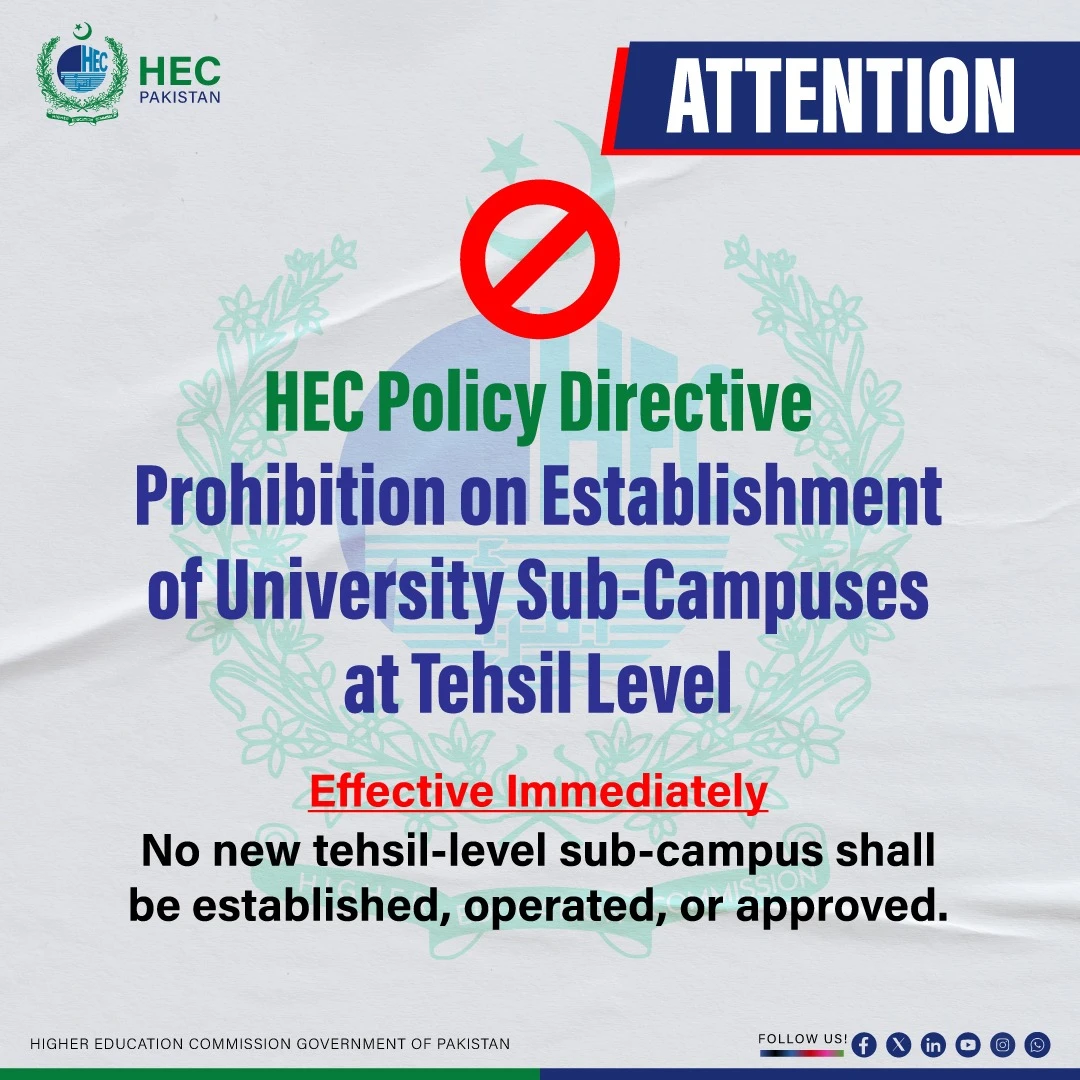
Higher Education Commission Pakistan (HEC) has imposed an immediate ban on the establishment and operation of university sub-campuses at the tehsil level across the country.
According to an official statement, the HEC has cancelled all pending applications related to the setup of sub-campuses. Universities in both the public and private sectors have also been instructed to immediately halt any ongoing plans for establishing such campuses.
The commission made it clear that any sub-campus set up without proper approval will not be granted academic recognition. Furthermore, degrees issued by these unauthorized campuses will not be accepted, raising serious concerns for institutions operating outside regulatory frameworks.
Officials highlighted several key issues behind the decision:
- A shortage of qualified PhD faculty
- Low student enrollment in many sub-campuses
- Inadequate infrastructure affecting the quality of education
These challenges, according to the HEC, were undermining the overall standard of higher education in Pakistan.
The HEC emphasized that the primary goal of this step is to improve the quality of higher education and ensure a uniform academic system nationwide. By restricting unchecked expansion, the commission aims to strengthen institutional performance and protect students from substandard educational experiences.
This decision is likely to impact universities planning to expand into smaller regions through sub-campuses. For students, it serves as a warning to verify the accreditation status of institutions before seeking admission.
As Pakistan continues to reform its higher education landscape, the HEC’s latest move signals a clear shift: quality will take precedence over rapid expansion

![9th Class Result [2026] BISE Multan Board](https://www.eduvision.edu.pk/edu_news/images/thumbs/multan-board.webp)